

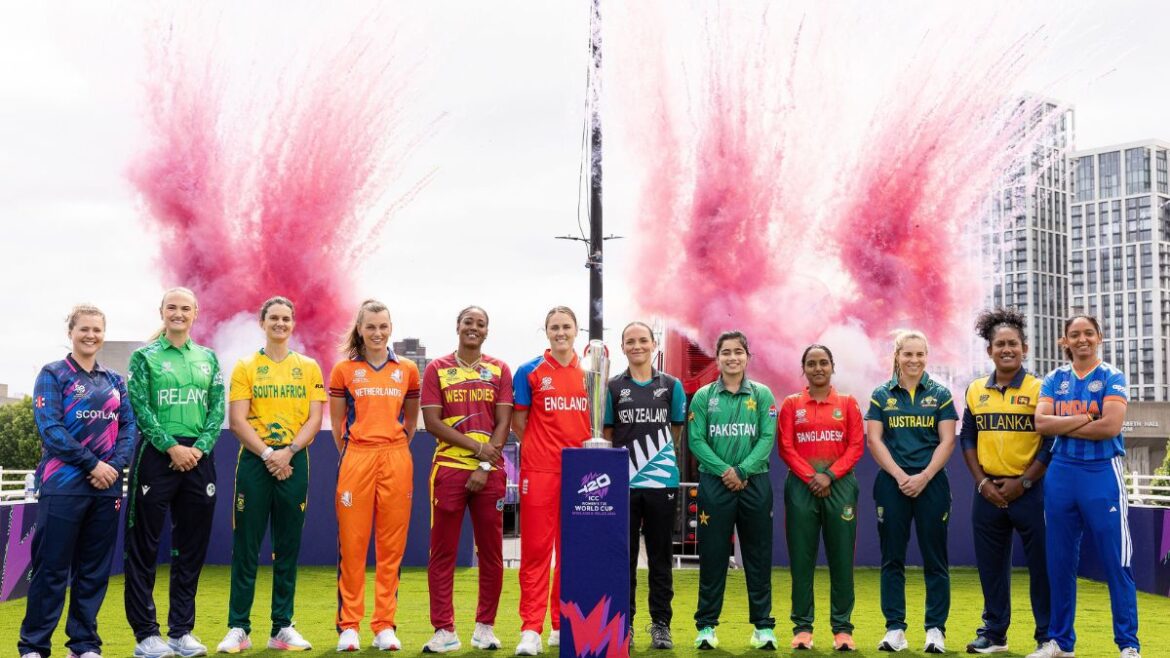
The ICC Women’s T20 World Cup 2026 is almost here. This landmark 10th edition will be staged in England, with New Zealand entering as defending champions after their 32‑run victory over South Africa in the 2024 final. The tournament begins on June 12, with England taking on Sri Lanka in the curtain-raiser.
While both the men’s and women’s tournaments share the same format of fast‑paced cricket and global excitement, there are some striking differences between them. Let’s break down the three biggest contrasts.
Also Read: Captain Sophie Molineux urges Australia to play with freedom at ICC Women’s T20 World Cup 2026
1. Prize Money
The financial rewards highlight the gap between the two tournaments.
- In the Men’s T20 World Cup 2026, winners India pocketed $2,639,423, while runners‑up New Zealand earned $1,422,692.
- For the Women’s T20 World Cup 2026, the ICC has allocated $2,340,000 for the champions and $1,170,000 for the runners‑up.
Although the women’s prize pool has grown compared to earlier editions, it still trails the men’s event. The narrowing of this gap is encouraging, but the disparity remains a talking point in the broader conversation about equality in cricket.
2. Participants
The scale of participation is another major difference.
- The Men’s edition in 2026 featured 20 teams, divided into four groups of five. The full list of participants was: India, New Zealand, South Africa, England, West Indies, Pakistan, Zimbabwe, Sri Lanka, Afghanistan, Australia, USA, Scotland, Ireland, Italy, Netherlands, UAE, Nepal, Canada, Namibia, Oman.
This expansion reflected the ICC’s push to globalise the sport, bringing in emerging cricket nations alongside established heavyweights.
- The Women’s edition in 2026 will feature 12 teams, split into two groups of six. This is the first time the women’s tournament has expanded to 12 teams, marking a significant milestone. The participants are: India, New Zealand, South Africa, England, West Indies, Pakistan, Sri Lanka, Australia, Scotland, Ireland, Netherlands, Bangladesh.
The difference in numbers illustrates the contrasting stages of development between men’s and women’s cricket. While men’s cricket has already embraced a broad global footprint, women’s cricket is steadily expanding, with the 2026 edition representing its largest field yet.
3. Dominance
The history of champions tells two very different stories.
- In the Men’s T20 World Cup, India created history in 2026 by becoming the first team to win the title three times. West Indies and England have each won twice, while Pakistan, Sri Lanka, and Australia have one title apiece. The men’s tournament has seen a relatively balanced distribution of champions, with multiple teams tasting success.
- In the Women’s T20 World Cup, the narrative has been dominated by one team: Australia. They have won six of the nine editions, establishing themselves as the undisputed powerhouse of the format. England, West Indies, and New Zealand have managed one title each, but Australia’s supremacy remains unmatched.
This contrast highlights how men’s cricket has fostered competitive parity, while women’s cricket has been defined by Australia’s near‑monopoly on success.
The Women’s T20 World Cup 2026 promises to be historic, not only because of its expanded format but also because of the growing competitiveness among teams. While differences in prize money, participation, and dominance remain, the trajectory of women’s cricket is clearly upward.
With New Zealand defending their crown and Australia aiming to reclaim their throne, fans can expect drama, rivalries, and perhaps a new chapter in the sport’s evolution.